August 14, 2024 · Cognac · Brandy · Spirits Guide
Cognac vs Brandy: The Real Difference, Explained
All cognac is brandy, but not all brandy is cognac. Here's the actual rule book — what changes between them, how to taste it, and what to buy for what occasion.
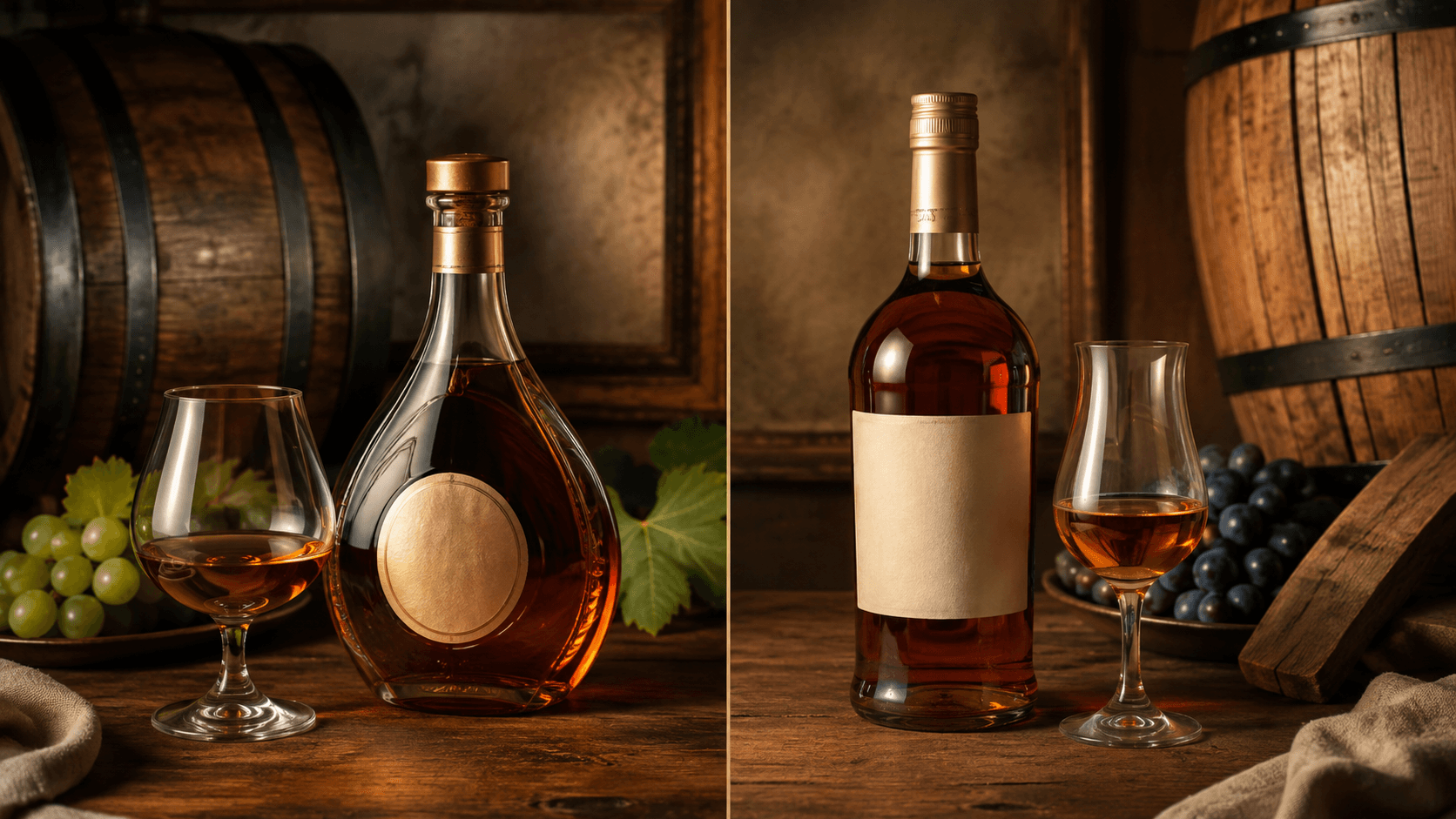
Walk into any liquor store and the same question hits half the customers in the cognac aisle: is this just expensive brandy? The short answer is yes and no. All cognac is brandy. Not all brandy is cognac. The difference comes down to geography, grapes, distillation, and a French regulatory body that does not mess around.
Here's the actual rule book, what each one tastes like, and what to buy depending on whether you're sipping it neat after dinner or building a sidecar at midnight.
| Factor | Cognac | Brandy (general) |
|---|---|---|
| Origin | Cognac region, France only | Anywhere in the world |
| Base | White grapes, mainly Ugni Blanc | Grapes or other fruit |
| Distillation | Twice in copper pot stills | Varies by producer |
| Ageing | French oak, graded VS/VSOP/XO | Varies widely |
| Best for | Refined sipping and gifting | Everyday sipping and cocktails |
Brandy: The Parent Category
Brandy is any spirit distilled from fermented fruit. Most often grapes — that's where wine-derived brandies like cognac come from — but apples, pears, cherries, and plums all make brandy too. The Spanish call apple brandy aguardiente. The Germans call cherry brandy kirschwasser. American applejack is technically apple brandy. The umbrella is wide.
What unites all brandies: fruit gets fermented into a low-alcohol base, then distilled to concentrate the alcohol and flavour. After distillation, most brandies age in oak barrels — that's where the warm caramel and vanilla notes come from. Cheap brandy gets minimum aging. Premium brandy gets decades.
Cognac: A Brandy With Rules
Cognac is a brandy that meets a specific set of French legal requirements. If your bottle doesn't follow every one of these rules, it cannot be called cognac. The rules:
- It must be made in the Cognac region of southwestern France (Charente and Charente-Maritime departments)
- It must be distilled from specific white grapes — primarily Ugni Blanc, with smaller amounts of Folle Blanche and Colombard allowed
- It must be double-distilled in copper pot stills
- It must age at least two years in French oak (Limousin or Tronçais)
If any of these rules break, the spirit can still be a brandy, but it can't carry the cognac name. The system is similar to how all champagne is sparkling wine but only sparkling wine from the Champagne region of France can be called champagne.
The Cognac Age Grades
Cognac labels follow a specific aging system — these letters mean exactly what they say:
- VS (Very Special): minimum 2 years aging. Younger, brighter, more cocktail-friendly. Hennessy VS is the workhorse
- VSOP (Very Superior Old Pale): minimum 4 years. Rounder, deeper, suitable for sipping or quality cocktails. Rémy Martin VSOP and Hennessy VSOP are common
- XO (Extra Old): minimum 10 years. Sipping cognac — drink neat, never mix
- Hors d'âge / XXO: beyond the chart. Very expensive, very old, exclusively for sipping
Other Brandies Worth Knowing
Cognac dominates the conversation, but other brandies are worth a place on the shelf:
- Armagnac — also French, also grape-based, but from a different region (Gascony). Distilled once in column stills instead of twice in pot stills. Funkier, rougher, more rustic character. Often a better value than equivalent cognac
- Spanish brandy — aged in sherry casks. Sweet, raisiny, distinctly different. Brandy de Jerez is the famous one
- American brandy — California makes most of it. Christian Brothers, E&J. Cheaper, lighter, fine in cocktails
- Pisco — South American grape brandy (Peru and Chile). Unaged or briefly aged. Backbone of the Pisco Sour
- Calvados — French apple brandy from Normandy. Crisp, fruity, perfect for fall cocktails
How to Taste the Difference
Pour a small measure of cognac VSOP and a small measure of a basic Spanish or American brandy side by side. Smell each first without sipping. Cognac usually leads with dried fruit, vanilla, floral notes from the Limousin oak, and a clean grape backbone. Spanish brandy comes through sweeter, with raisin and prune. American brandy reads cleaner, simpler, less complex.
Sip each neat at room temperature. Cognac feels silkier on the palate, with a longer finish. Basic brandy lands harder and finishes shorter. Once you've done this comparison once, you'll never confuse them again.
What to Buy for What Occasion
For a nightcap or after-dinner sipping — cognac VSOP or XO, served neat in a tulip glass, room temperature. Hennessy and Rémy Martin are the safest bets.
For cocktails like a Sidecar, French 75, or Brandy Alexander — cognac VS, or a quality American brandy. Don't waste XO in a shaker.
For cooking (deglazing pans, finishing sauces) — cheap American brandy. The flavour cooks down anyway. Save the cognac for the glass.
For something different — try an Armagnac VSOP. Same price tier as cognac, distinctly different character. Or a Calvados in late September.
Order Cognac or Brandy in the GTA
J&J Alcohol Delivery carries Hennessy VS, Hennessy VSOP, Rémy Martin, and other cognacs across Toronto, Mississauga, Brampton, Vaughan, Markham, Richmond Hill, Oakville, Burlington, and North York. 24/7 same-day delivery, 35-minute average. Call (437) 328-0030 or order at jnjalcoholdelivery.ca.
Cognac Delivery in the GTA — FAQ
How much does cognac delivery cost in Toronto?
Delivery is a flat rate with no late-night surge or weekend markup — the price you see at checkout is what you pay at the door.
Can I send cognac as a gift in the GTA?
Yes — order cognac to any GTA address. Just make sure someone 19+ with valid photo ID is there to receive it, since our drivers verify age on delivery.
Do you deliver cognac in Toronto?
Yes — J&J Alcohol Delivery delivers cognac across Toronto and the GTA 24/7, usually in under 45 minutes, with valid 19+ ID checked at the door.
Can I get cognac delivered late at night in the GTA?
Absolutely. We're open 24 hours a day, so you can order cognac long after the LCBO closes — same-day and after-hours across Toronto, Mississauga, Brampton, Vaughan, and beyond.
By J&J Alcohol Delivery
Back to BlogKeep Reading
More Articles
Toronto events
Toronto Oktoberfest 2026: Fort York Dates, Tickets and Weekend Plans
The September 25-26 Toronto Oktoberfest dates, venue and session details, plus an evergreen plan for a Bavaria…
Toronto events
Toronto Garlic Festival 2026: Allan Gardens and a Sunday Supper Plan
The September 27 Garlic Festival at Allan Gardens has ended. Find the archived visitor details and ideas for t…