
November 17, 2026 · wine · sparkling wine · hosting · holiday party · how-to · November 2026
How to Open Wine Without a Corkscrew (and Chill It Fast): Fixes for Hosts Before the Holidays
No corkscrew, a cork that snapped or a bottle that's too warm: the opening methods that work, ranked by how safe and reliable they are, the viral tricks to skip, a salted ice bath for chilling wine and beer fast, and how to open bubbly without a flying cork.
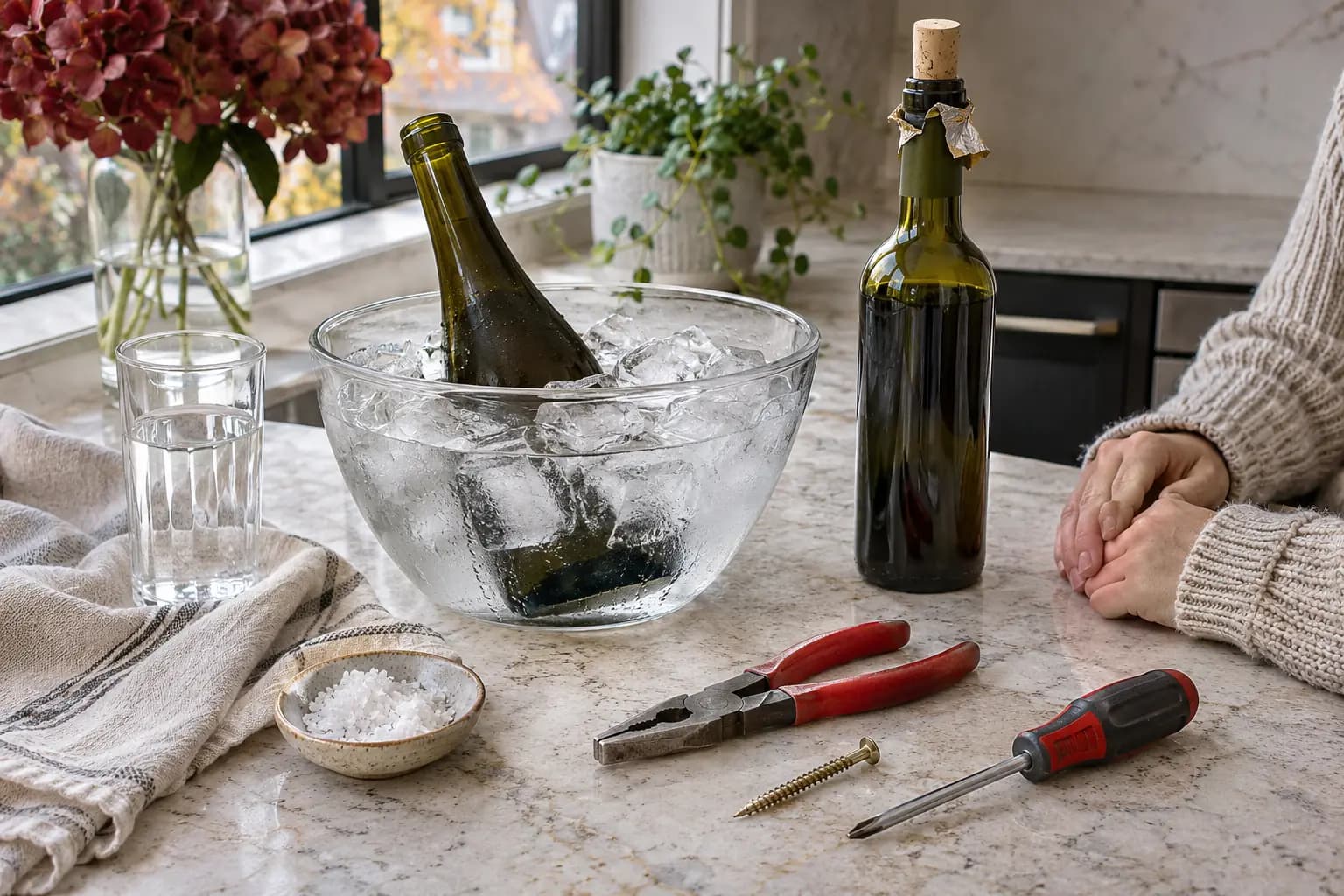
The most reliable way to open wine without a corkscrew is a screw and a pair of pliers: drive a long screw into the cork, grip the head with the pliers and pull the cork straight up. No toolbox? A house key does the same job more slowly, and pushing the cork down into the bottle works almost every time. Before you try any of it, check the top of the bottle. Plenty of wine is sealed with a screw cap and needs no tool at all.
Holiday hosting is starting, Beaujolais Nouveau arrives this Thursday, and the corkscrew is always the thing nobody can find. Below are the fixes we'd actually use, ranked by how safe and reliable they are, the viral tricks we'd skip, what to do when the cork snaps, how to chill a warm bottle fast and how to open bubbly without a flying cork. The images are original editorial illustrations.
First, check the cap: screw caps and synthetic corks
Peel back the foil before you go hunting for tools. What's under it decides which fix to use.
- Screw cap: no tool needed. Hold the bottle by the body, grip the cap firmly and twist until the seal clicks. If your hands are wet or the cap is stiff, use a tea towel for grip.
- Natural cork: every method below works. Natural cork is softer and grips a screw or key well.
- Synthetic (plastic) cork: denser and springier than natural cork. It's hard to push in and a key tends to slip, so go straight to the screw and pliers.
- Crown cap (like a beer cap), found on some sparkling wines: a bottle opener is all you need.
- Sparkling wine with a wire cage: this cork never needs a corkscrew. Skip to the section on opening sparkling wine safely.
How to open wine without a corkscrew: methods that work
These are the three methods we'd use, in the order we'd try them. The ranking is our own judgment, based on how much can go wrong with each one.
| Method | What you need | How reliable | Watch out for |
|---|---|---|---|
| 1. Screw and pliers | A long wood screw, a screwdriver, pliers or the claw of a hammer | The most reliable, and it works on natural and synthetic corks | Pulling at an angle, which can split the cork |
| 2. House key | A sturdy key, ideally an old one | Good with natural cork and a bit of patience | Crumbly old corks, and bending a key you need |
| 3. Push the cork in | The handle of a wooden spoon or something similar, a sink, a tea towel | Almost always opens the bottle | Splashes, stiff synthetic corks, and never with sparkling wine |
1. Screw and pliers
- Pick the longest wood screw you have, ideally one that can go most of the way through the cork. A short screw just pulls out of the top.
- Stand the bottle on a counter and drive the screw into the centre of the cork, straight down, with a screwdriver. Leave about a centimetre showing.
- Grip the screw head with pliers (or hook it with the claw of a hammer) and pull straight up, slowly. Hold the bottle by the body, not the neck.
- If the cork starts to tear, stop, drive the screw in a little deeper and try again.
2. A house key
- Push the key into the cork at a 45-degree angle, as deep as it will go.
- Hold the bottle steady and turn the key in a circle while lifting gently, so the cork works its way up the neck.
- Once the cork is a centimetre or two out, finish the job with your fingers or a tea towel.
Use an old or spare key. A key that bends or snaps halfway through the cork turns one problem into two. A sturdy screwdriver works the same way, and a serrated bread knife pushed in and twisted is the version we'd avoid, for the reasons in the next section.
3. Push the cork into the bottle
- Stand the bottle in the sink and lay a tea towel over the top. Wine can spurt out as the cork drops.
- Press the cork down with the handle of a wooden spoon, using slow, steady pressure. Don't hammer it.
- Once the cork drops, pour slowly. The cork floats and can block the neck, so hold it back with a chopstick or pour into a jug or decanter first.
This one is the last resort because you can't put the cork back, so the bottle needs finishing or decanting. It's also hard work with a synthetic cork, and it's not an option for sparkling wine at all.
Tricks to skip and why
Social media is full of ways to open wine with whatever's in the kitchen drawer. A few of them are fine. These ones risk a broken bottle or a cut hand, and we wouldn't use them.
- The shoe against the wall: you're knocking a glass bottle against a hard surface, again and again, while holding it. If the glass has a chip or flaw, it can break in your hand. It also shakes the wine and any sediment in it. Not worth it, especially with an older or thin-walled bottle.
- A knife driven into the cork: a blade can slip off a round, rubbery cork and straight into the hand holding the bottle. Scissors and stabbing with a screwdriver have the same problem.
- Heating the neck with a lighter or torch: sudden heat on glass is how bottles crack. You're also holding a flame right next to your hand.
- Sabering bubbly with a kitchen knife: even the Champagne trade body, the Comité Champagne, describes sabrage as "a bit risky and can even be dangerous". It's a party trick for people who've been taught, not a fix for a missing tool.
Our rule of thumb: if a method involves a blade near your hand, banging glass on something hard, or heat on the bottle, skip it and use a screw, a key or the push-in method instead.
The cork broke: how to save the bottle
A snapped cork usually means the top half came out and the bottom half is still in the neck. It happens most with old, dry corks, or when a corkscrew or screw didn't go in deep enough. The wine is fine. You just need to get the rest of the cork out of the way.
- If you still have a corkscrew: wind it into what's left at a slight angle, so it bites into the cork rather than the gap, and pull up very slowly.
- If not: use the screw and pliers on the stub. A shorter piece of cork comes out more easily than a full one.
- If it keeps crumbling: stop fighting it and push the rest into the bottle, as above.
- Strain out the bits: pour the wine through a fine sieve or a paper coffee filter into a jug or decanter. Bits of cork don't spoil the wine; they just aren't nice to find in your glass.
Chilling wine, beer and bubbly fast: the ice, water and salt method
Ice on its own chills slowly, because there are air gaps between the cubes and air doesn't pull heat out of a bottle very well. Wine Spectator recommends a mix of ice and cold water instead, which wraps the whole bottle. Add salt and it gets faster again. Salt lowers the freezing point of the water, so more of the ice melts and the bath drops below 0°C.
In a test by America's Test Kitchen, white wine starting at about 24°C (75°F) reached about 3°C (38°F) in 34 minutes in salted ice water. The same wine took 67 minutes in the freezer and 105 minutes in plain ice water. That 3°C is colder than most wines need, so a bottle that only has to get to a pleasant chill gets there sooner.
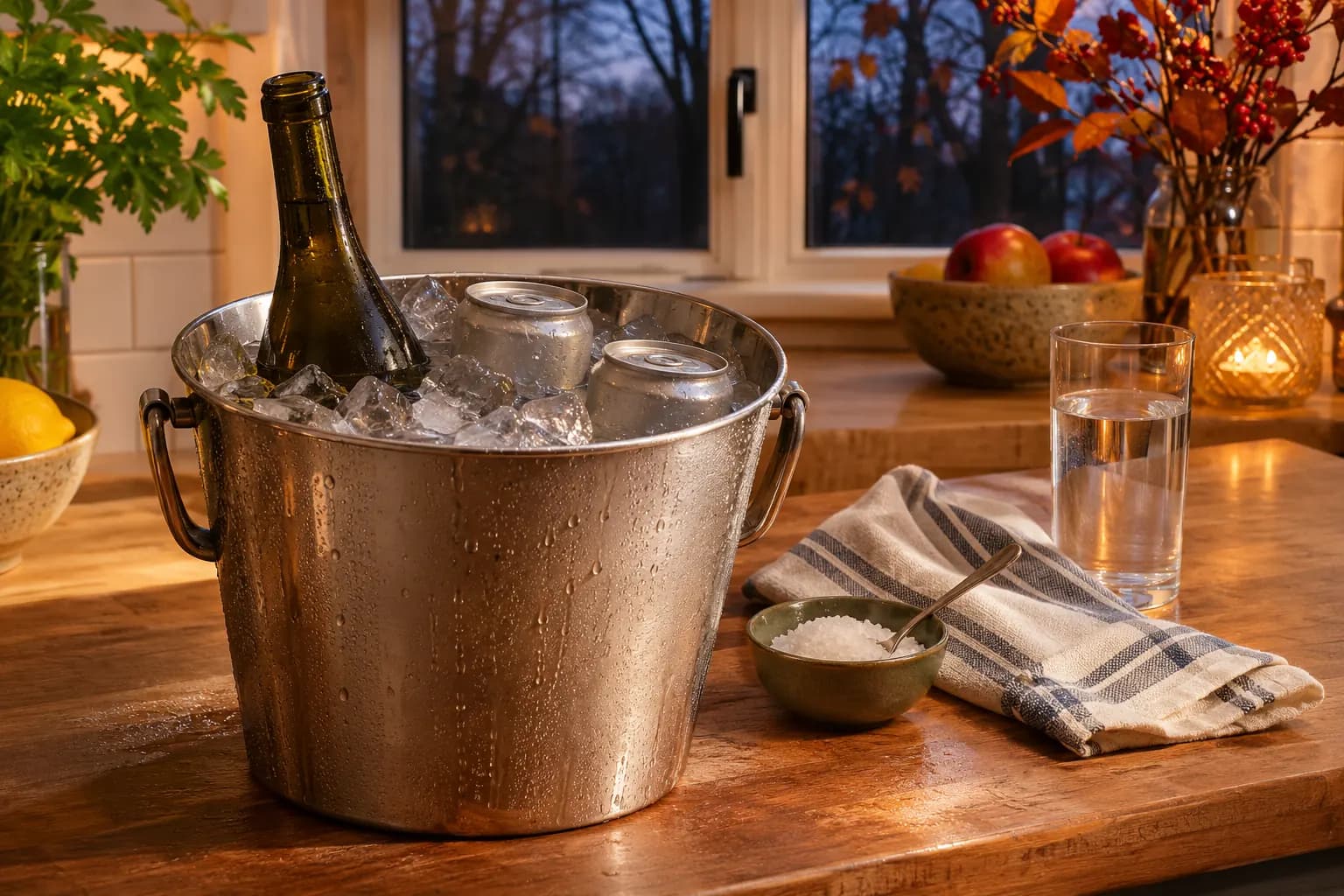
- Find something deep enough to cover the bottle up to its neck: an ice bucket, a stock pot or a clean sink.
- Fill it with ice, then add cold water. America's Test Kitchen used about four parts ice to one part water.
- Stir in a generous amount of salt. Their test used about 250 ml (1 cup) of table salt for roughly 4 litres of ice and 1 litre of water. Any cheap salt works.
- Push the bottle or cans down into the bath so they're covered to the neck.
- Check the temperature at 15 minutes. A light white or rosé may already be cool enough to pour; sparkling wine needs longer.
| Method | Rough time | Notes |
|---|---|---|
| Salted ice water | About half the freezer time; 34 minutes from room temperature to fridge-cold (about 3°C) in ATK's test | The quickest option if you have salt and ice |
| Ice and cold water | About 10 minutes to bring a warm red down, up to 30 for sparkling (Wine Spectator); 105 minutes from room temperature to fridge-cold in ATK's test | The Comité Champagne suggests 20 to 30 minutes in a bucket half ice, half water for Champagne |
| Freezer | About 15 minutes to take the edge off (Wine Spectator); 67 minutes from room temperature to fridge-cold in ATK's test | Set a timer. A forgotten bottle can freeze and push its cork out |
| Fridge | An hour or two for a white or bubbly | Fine if you planned ahead |
How to chill beer quickly
The same salted ice bath works for beer, and cans usually cool quicker than glass bottles. Pack them in so each one is surrounded by ice water, not stacked on top of each other. With beer and sparkling wine, don't roll or shake them in the bath to speed things up. A shaken can or bottle foams over when you open it, and a shaken bottle of bubbly is much more likely to send its cork flying.
Wine too warm? What to do
A red that's been sitting near the oven or a radiator all afternoon tastes flat and boozy. Wine Spectator suggests about 10 minutes in ice and water to bring a red back down, or some time in the fridge. These are the serving temperatures they recommend (the grape examples are ours):
| Wine | Serve at | What that looks like at home |
|---|---|---|
| Light dry whites, rosé, sparkling | About 4 to 10°C (40 to 50°F) | Straight from the fridge, or an ice bath |
| Champagne | 8 to 10°C | 20 to 30 minutes in an ice bucket, or a few hours at the bottom of the fridge |
| Fuller whites (oaked Chardonnay) and light, fruity reds (Gamay, Pinot Noir) | About 10 to 16°C (50 to 60°F) | Lightly chilled |
| Full-bodied reds (Cabernet, Syrah) | About 16 to 18°C (60 to 65°F) | A little below room temperature |
Wine warms up in the glass, so it's better to start a little cooler than the target than a little warmer. If a white comes out too cold, cupping the glass in your hands for a minute takes the edge off.
How to open champagne safely
A sparkling wine cork is held in by pressure, and that pressure is what makes it dangerous. The Comité Champagne warns that "the pressure in the bottle can send the cork flying, especially if the bottle has been shaken up a bit", and its advice is to keep a firm grip on the cork and never point the bottle at anyone. A cold bottle is calmer than a warm one, so chill it properly first. Here's how we'd open any bottle of Champagne, Prosecco or cava:
- Chill it: 8 to 10°C, or 20 to 30 minutes in a bucket of ice and water. Wipe the bottle dry so it doesn't slip.
- Point it away: tilt the bottle to about 30 to 45 degrees, away from people, lights and anything breakable.
- Thumb on the cork: remove the foil and loosen the wire cage, keeping your thumb or palm pressed on top of the cork from that moment on. A tea towel over the top gives you a better grip.
- Turn the bottle, not the cork: hold the cork still and slowly rotate the bottle from its base. Let the pressure ease the cork out into your hand. You want a soft sigh, not a pop.
- Pour in two stages: a little in each glass first, let the foam settle, then top up to about two-thirds.
Never use a corkscrew on a sparkling wine cork, and never try to push one in. If a cork is stuck, wrap it in a tea towel for grip and keep turning the bottle slowly. Don't lever it with tools.
Close leftover bubbly straight away with a proper sparkling wine stopper and keep it cold. The Comité Champagne's advice is that an opened bottle won't keep for long, so plan to finish it soon. When you're choosing a bottle for the toast, browse our champagne and sparkling wine.
The host's small-tools kit for the holidays
None of this kit costs much, and having it in one drawer saves the scramble when guests are at the door.
- A waiter's friend corkscrew, the folding kind with a small foil cutter. Then a cheap spare, kept somewhere nobody borrows it from.
- A sparkling wine stopper for leftover bubbly.
- A bucket or tub deep enough to cover a wine bottle to the neck.
- A box of cheap salt kept with the bucket, for fast chilling.
- A fine sieve or paper coffee filters for the night a cork crumbles.
- A bottle opener for beer and crown-capped sparkling wine.
- A few clean tea towels for grip, drips and opening bubbly.
- A water jug and tall glasses, set out next to the wine, with sparkling water or a non-alcoholic option for drivers and anyone not drinking.
A screw-cap bottle or two in the rack is a good backup too. If you're still working out what to pour, our guide to wine for a dinner party covers styles and how much to buy, and our wine selection shows what's in stock. Plan the ride home for anyone who's drinking before the first bottle is open.
FAQ: Opening and chilling wine
Frequently Asked Questions
Is a pushed-in cork okay?
Yes. The wine is fine to drink with the cork floating in it. Pour slowly and hold the cork back with a chopstick, or decant the whole bottle into a jug. The catch is that you can't recork it, so cover the neck with plastic wrap or a wine stopper and keep any leftovers in the fridge.
Can you put wine in the freezer?
Yes, for a short time. Wine Spectator puts it at about 15 minutes. Set a timer, because a forgotten bottle can freeze and push its cork out. With sparkling wine we'd use an ice bucket instead, which is what the Comité Champagne recommends.
How cold should red wine be?
Cooler than most people serve it. Wine Spectator suggests about 16 to 18°C (60 to 65°F) for full-bodied reds; think Cabernet or Syrah. For light, fruity reds it suggests about 10 to 16°C (50 to 60°F); we'd put Gamay and Pinot Noir there. In a warm room, 10 minutes in ice water or a short spell in the fridge gets a red there.
What do I do if the cork broke halfway?
Wind a corkscrew or a long screw into the piece that's left, at a slight angle, and pull slowly. If it keeps crumbling, push the rest into the bottle and strain the wine through a fine sieve or coffee filter.
How do I chill wine fast without a freezer?
Fill a bucket or pot with ice, add cold water and stir in a good amount of salt, then submerge the bottle to its neck. In America's Test Kitchen's test, salted ice water chilled a white from room temperature to about 3°C in 34 minutes, faster than the freezer or plain ice water.
Can I get wine or champagne delivered tonight?
Yes. Our 24-hour alcohol delivery runs every day across the GTA, including weekends and holidays, and delivery is free on orders over $150. Someone 19 or older has to receive the order with valid photo ID, which our drivers check at the door, and we can't leave alcohol with a concierge or front desk.
Hosting this week and short a bottle, a bag of ice or both? Our 24-hour alcohol delivery covers the GTA every day, or call or WhatsApp (437) 328-0030 and we'll help you pick.
By J&J Alcohol Delivery
Back to BlogKeep Reading
More Articles

office party
Office Holiday Party Drinks in the GTA: A Planner's Guide to Budget, Bar Setup and Getting Everyone Home
For the person who got handed the office party: open bar vs drink tickets vs beer and wine only, how to set a …

Scotch
Single Malt vs Blended Scotch: What the Labels Mean, What 'Peaty' Tastes Like and Which to Buy
The five Scotch categories in one table, the myths about single malt, what peat actually does to the flavour, …