November 20, 2026 · kosher wine · Hanukkah · wine pairing · holiday hosting · non-alcoholic · December 2026
Hanukkah 2026 Wine Guide: Kosher Wine, Mevushal and Pairings
Hanukkah 2026 starts at sundown on Friday, December 4. What makes a wine kosher, what mevushal means and why it matters to some hosts, the symbols to look for on the label, pairings for latkes, brisket, roast chicken and sufganiyot, and how a Friday-night start changes the timing.
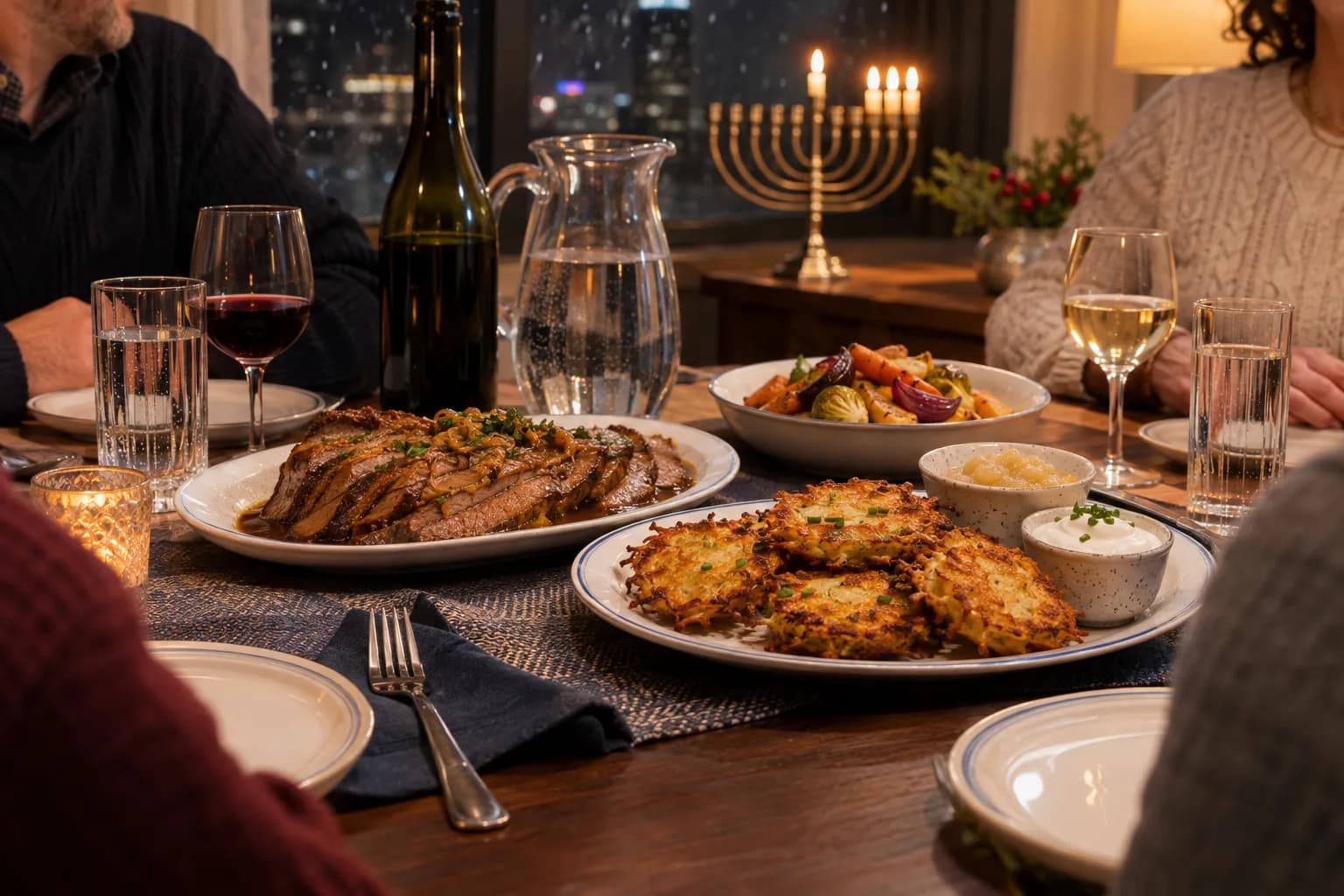
Kosher wine for Hanukkah is wine made under rabbinic supervision and sealed with a certification symbol (a hechsher) from an agency such as COR or the OU. The grape, the country and the price don't make a wine kosher. The supervision does, and the symbol on the bottle is how you know. If some of your guests keep kosher, check every bottle for that symbol, and look for the word "mevushal" if anyone other than an observant guest will be opening or pouring.
Hanukkah starts two weeks from tonight, at sundown on Friday, December 4. Below are the dates, what kosher and mevushal mean in plain terms, how to read a label, what to pour with latkes, brisket and sufganiyot, and how a Friday-night start affects your planning. We're a delivery service, not a kashrut authority, so for questions about your own practice, ask your rabbi. The images are original editorial illustrations.
Hanukkah 2026 dates: December 4 to 12
Hanukkah 2026 begins at sundown on Friday, December 4, and the menorah is lit on each of the eight evenings, as Chabad's Chanukah guide sets out. The last candles are lit on Friday, December 11, and the eighth day is Saturday, December 12. Because Hanukkah follows the Hebrew calendar, its date moves around on ours. This year, both Fridays of the holiday carry a candle-lighting, which matters for timing (more on that below).
| Night | Date | Candles | Timing note |
|---|---|---|---|
| 1 | Friday, December 4 | 1 | Lit before sundown, ahead of Shabbat |
| 2 | Saturday, December 5 | 2 | After Shabbat ends at nightfall |
| 3 | Sunday, December 6 | 3 | At dusk |
| 4 | Monday, December 7 | 4 | At dusk |
| 5 | Tuesday, December 8 | 5 | At dusk |
| 6 | Wednesday, December 9 | 6 | At dusk |
| 7 | Thursday, December 10 | 7 | At dusk |
| 8 | Friday, December 11 | 8 | Lit before sundown, ahead of Shabbat |
What makes a wine kosher
Grapes themselves are just fruit. What makes the wine kosher is how it's made and who makes it, not how it tastes. COR (the Kashruth Council of Canada), the Toronto-based kosher certifier, puts it simply in its kosher FAQ: "all wine and grape juice must be made by people of Jewish faith and carry reliable kosher supervision." That includes grape juice, so the bottle of juice for the kids' table or for anyone not drinking needs a symbol too.
A few things kosher doesn't mean:
- It isn't a style. Kosher wine can be red, white, rosé, sparkling, dry or sweet, and made from Cabernet, Merlot, Chardonnay or any other grape.
- It isn't a country. Kosher wine is made in Israel, France, Italy, Spain, California, South America and elsewhere, and in each of those places kosher wineries sit alongside ones that aren't.
- It isn't a quality level. The sweet, syrupy bottle many people remember from family seders is one kind of kosher wine, not the whole category. Our view: shop for kosher wine the way you'd shop for any other wine, by grape, region and style.
Mevushal vs non-mevushal, and why it matters to some hosts
Mevushal means "cooked". A mevushal wine has been heated after it's made, which today usually means flash pasteurization: the wine is heated very quickly and cooled again. Kosher authorities set different minimums for how hot it has to get. OU's article on mevushal and mifustar wine notes that Rav Moshe Feinstein required more than 175°F (about 79°C), while the Tzelemer Rav insisted on at least 190°F (about 88°C). The OU allows flash-pasteurized wine to be labelled either "mevushal" or "mifustar" (pasteurized).
Here's why it matters at a dinner table. Once a kosher wine is mevushal, it keeps its kosher status no matter who opens or pours it. A non-mevushal kosher wine is different: for guests who are strict about this, it should be opened and poured only by an observant Jew. In the OU's words, mevushal wine "may be handled, and even poured by a non-Jew or a non-shomer Shabbos Jew", while an opened bottle of non-mevushal wine "must be closely guarded, since it can become forbidden if left unattended."
- You keep kosher and Shabbat, and so do your guests: any certified kosher wine works, mevushal or not, as long as an observant guest opens and pours it.
- Anyone else hosting observant guests, whether you're not Jewish, don't keep Shabbat, or are hosting a mixed crowd, an office party or a catered event: choose mevushal. That way anyone can open the bottle, the caterer can pour it, and your observant guests can still drink it.
- You're bringing a bottle as a guest: mevushal is the safer gift, because you don't know who will end up opening it. Ask the host if you're unsure.
Is mevushal wine worse? Some wine lovers think heating flattens the flavour. Flash pasteurization is quick, though, and the same OU article notes that even experts debate whether it changes the wine at all. For a big table with a lot of hands on the bottles, we'd pick mevushal without a second thought.
Reading the label: certification symbols to look for
Not every bottle in a general wine catalogue is kosher, and that includes ours. You can't tell from the name or the country. Turn the bottle around. What you're looking for:
- A hechsher (certification symbol): a small logo from a kosher agency, usually on the back label or the neck. In Canada you'll often see the COR mark. The OU (a U inside a circle) is common on imported bottles. There are many other reliable agencies, and COR offers a kosher symbol reference card and app if you see one you don't recognize.
- The word "mevushal" (or "mifustar"): printed near the symbol, often in English and Hebrew. If it doesn't say mevushal, assume it isn't.
- An intact seal: COR's guidance is to check the symbol on the original sealed packaging. Once a bottle has been opened by someone else, the label alone doesn't tell you much.
A word of caution from COR that applies to wine too: "Relying on the attendant to provide you with answers is not sufficient." That goes for us. We can tell you what's on a label, but the symbol on the bottle is what counts, so check it yourself when it arrives.
If you want a wide choice, the LCBO website lets you search for kosher wines. Selection varies by store, so check before you go.
Pairings for latkes, brisket, roast chicken and sufganiyot
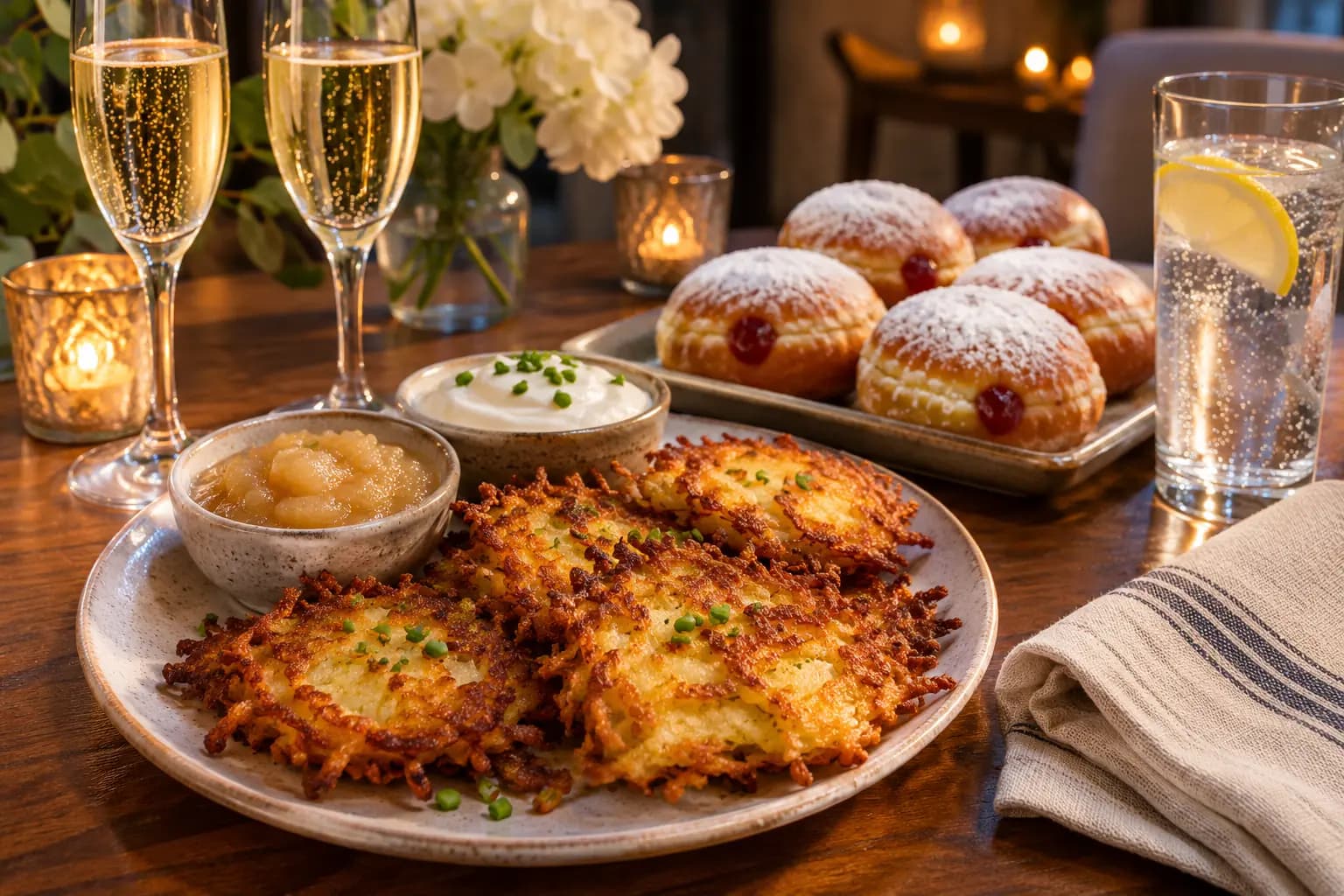
Hanukkah food is fried, rich and often salty, which tells you most of what you need to know about the wine. You want acidity or bubbles to cut through the oil, and for the meat course, enough body to stand up to a braise. These pairings are our suggestions by style. They work whether the bottle is kosher or not, so pick a certified kosher version of the style if your table needs one.
| Dish | What to pour | Why it works |
|---|---|---|
| Latkes with applesauce or sour cream | Dry sparkling wine, Sauvignon Blanc, dry Riesling, unoaked Chardonnay | Bubbles and acidity cut through the oil and salt |
| Brisket | Cabernet Sauvignon, Merlot, Malbec, Syrah or a red blend | Enough body and tannin for slow-cooked beef and its gravy |
| Roast chicken | Pinot Noir, a lighter Merlot, or an oaked Chardonnay | Medium body that doesn't drown the chicken |
| Sufganiyot and other sweets | Moscato d'Asti or another lightly sweet sparkling wine, or a small glass of dessert wine | The wine should be at least as sweet as the doughnut |
Latkes
Our favourite pairing on this list is latkes and a dry sparkling wine. Bubbly and fried potato is the same idea as Champagne and chips, and it's a great match. If bubbles feel too formal, a crisp Sauvignon Blanc or a dry Riesling does the same job. Skip big, oaky whites with latkes. They make the plate feel heavier.
Brisket
Brisket is the place for your fullest red. A Cabernet Sauvignon or a Merlot-based blend is the classic match, and a Malbec or Syrah works if your recipe is on the sweeter, saucier side. Open it half an hour before dinner, and serve it a little below room temperature rather than warm from a counter next to the oven.
Roast chicken
Chicken is flexible. A Pinot Noir is the one bottle that suits both the chicken and the latkes on the side, which makes it the easiest choice for a small dinner when you only want to open one red.
Sufganiyot
Jam doughnuts make dry wine taste sour, so pour something sweeter or pour coffee instead. A lightly sweet, low-alcohol sparkling wine like Moscato d'Asti suits the end of a long meal. Small glasses are plenty.
For more on how many bottles to buy and how to pace a dinner, see our guide to wine for a dinner party. Browse our wine selection for the styles above. Our range changes, so these are styles, not a claim that J&J stocks a particular kosher bottle on a given night.
Sparkling wine and non-alcoholic options for the whole table
Eight nights is a lot of evenings, and most of them are weeknights with work and school the next day. Hanukkah is a family holiday with kids at the table, so plan the drinks for everyone, not just the adults having wine.
- Bubbly for the first or last night: one bottle of sparkling wine gives about six flute pours, enough for a toast at a table of six. Browse our champagne and sparkling wine, or pick a certified kosher sparkling if your guests need one.
- Kosher grape juice: sparkling or still, for kids and anyone not drinking. As COR notes, grape juice needs a kosher symbol just like wine.
- Sparkling water: in tall glasses next to every wine glass, with lemon or a splash of juice.
- Non-alcoholic wine: if you buy it for observant guests, check it for a hechsher too, since it's still a grape product.
Keep the pours modest across the eight nights. Smaller glasses and a water glass beside every wine glass make that easy. Wine stays at the adults' end of the table. In Ontario, the legal drinking age is 19.
Planning around a Friday-night start
This year Hanukkah starts on a Friday, so the first night runs straight into Shabbat. For many families, that changes the order of the evening and the shopping schedule. Chabad's Chanukah guide (linked above) explains the timing:
- Friday, December 4 and Friday, December 11: the menorah is lit before the Shabbat candles, which are lit 18 minutes before sundown. The candles have to last until about half an hour after nightfall, so the standard 30-minute Hanukkah candles won't do. Buy longer candles or extra oil ahead of time.
- Saturday, December 5: the menorah is lit only after Shabbat ends at nightfall. Chabad says not to touch or prepare the menorah until after havdalah.
- Customs vary on details such as the order of havdalah and the menorah on Saturday night. Follow your family's practice.
What this means for drinks: sunset comes early in December, so Friday afternoon is short. If your household doesn't shop or take deliveries on Shabbat, have the wine, grape juice and anything else in the house by Friday morning, or by Thursday to be safe. Our delivery page explains how ordering works, and you can request a scheduled delivery by WhatsApp. If you're hosting a Saturday-night party once Shabbat ends, an order later that evening works too. Someone 19 or older with valid photo ID has to receive it, and our drivers check ID at the door.
Whichever night you host, plan the ride home for anyone who's been drinking before the first glass is poured. On a December night, a taxi, transit or a designated driver is part of the plan, not an afterthought.
FAQ: Kosher wine for Hanukkah
Frequently Asked Questions
Is all Israeli wine kosher?
No. Many Israeli wineries are kosher-certified, but certification is per winery and per bottle, and not every Israeli wine carries it. The country on the label tells you nothing on its own. Look for a hechsher on the bottle.
What does mevushal mean on a wine label?
It means "cooked": the wine has been heated, usually by flash pasteurization, so it stays kosher whoever opens or pours it. Some bottles say "mifustar" (pasteurized) instead. If anyone other than an observant guest, such as a caterer or a server, will be pouring, choose mevushal.
Is kosher wine always sweet?
No. Sweet sacramental wine is one style of kosher wine. Kosher wines also include dry reds, crisp whites, rosé and sparkling, from the same grapes as any other wine.
Can I ask for kosher wine for delivery?
Yes, call or WhatsApp (437) 328-0030 and ask. Our range changes and we can't promise a kosher bottle will be in stock on a given night. If we have one, check the hechsher and the seal yourself when it arrives, since the symbol on the bottle is what counts.
Does grape juice need to be kosher too?
For guests who keep kosher, yes. COR says all wine and grape juice must carry reliable kosher supervision, so buy grape juice with a symbol for the kids' table and non-drinkers.
Do your drivers check ID at the door?
Every time. The person receiving the order must be 19 or older with valid photo ID. The name doesn't have to match the order, but someone of age has to be there. We won't leave alcohol with a concierge or front desk, and if nobody of age is home, the order goes back and a restocking fee may apply.
Planning the first night or the last? Call or WhatsApp (437) 328-0030 through our contact page to ask what we have before Friday, December 4, and we'll help you pick for latkes, brisket and the toast.
By J&J Alcohol Delivery
Back to BlogKeep Reading
More Articles
office party
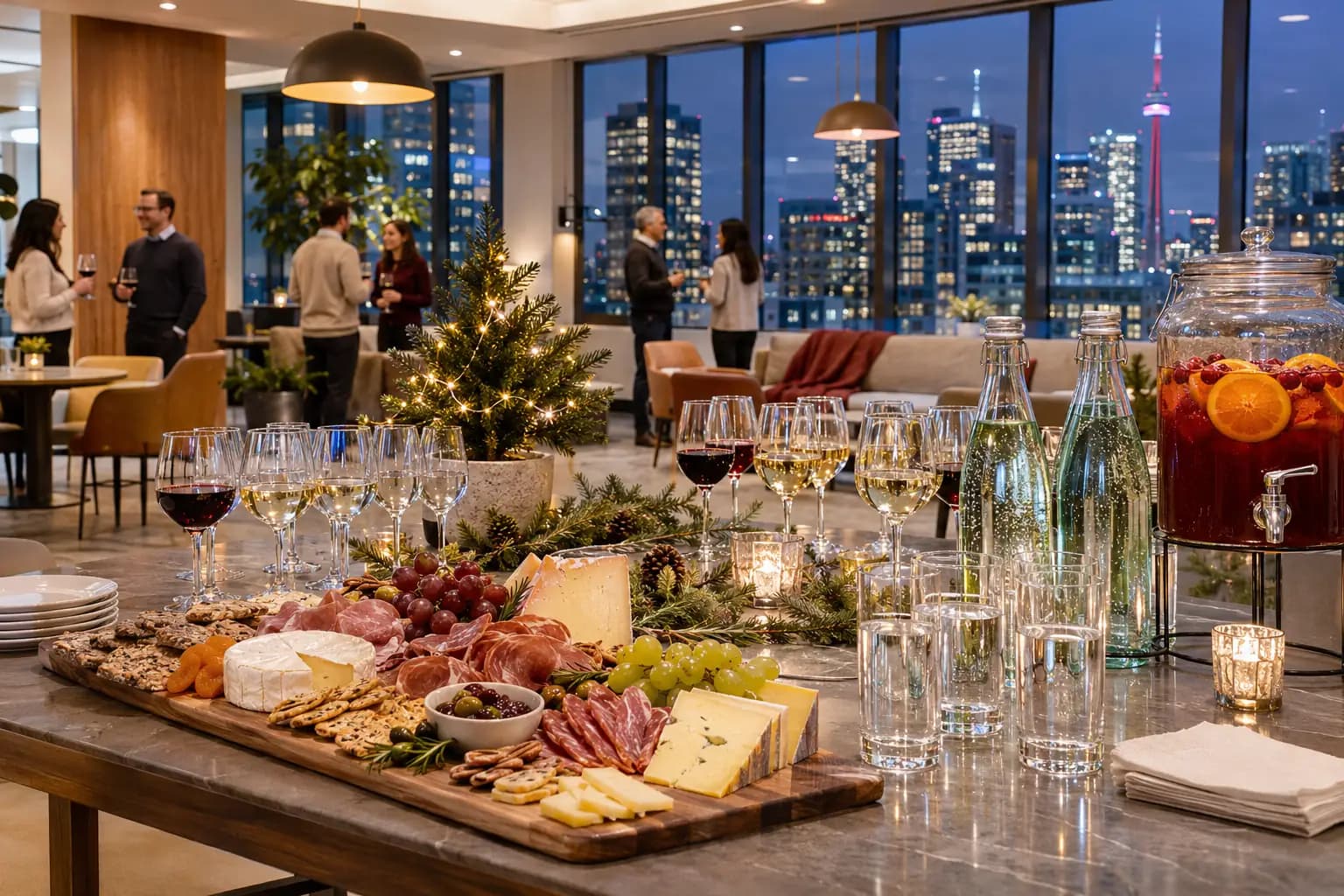
Office Holiday Party Drinks in the GTA: A Planner's Guide to Budget, Bar Setup and Getting Everyone Home
For the person who got handed the office party: open bar vs drink tickets vs beer and wine only, how to set a …
wine
How to Open Wine Without a Corkscrew (and Chill It Fast): Fixes for Hosts Before the Holidays
No corkscrew, a cork that snapped or a bottle that's too warm: the opening methods that work, ranked by how sa…